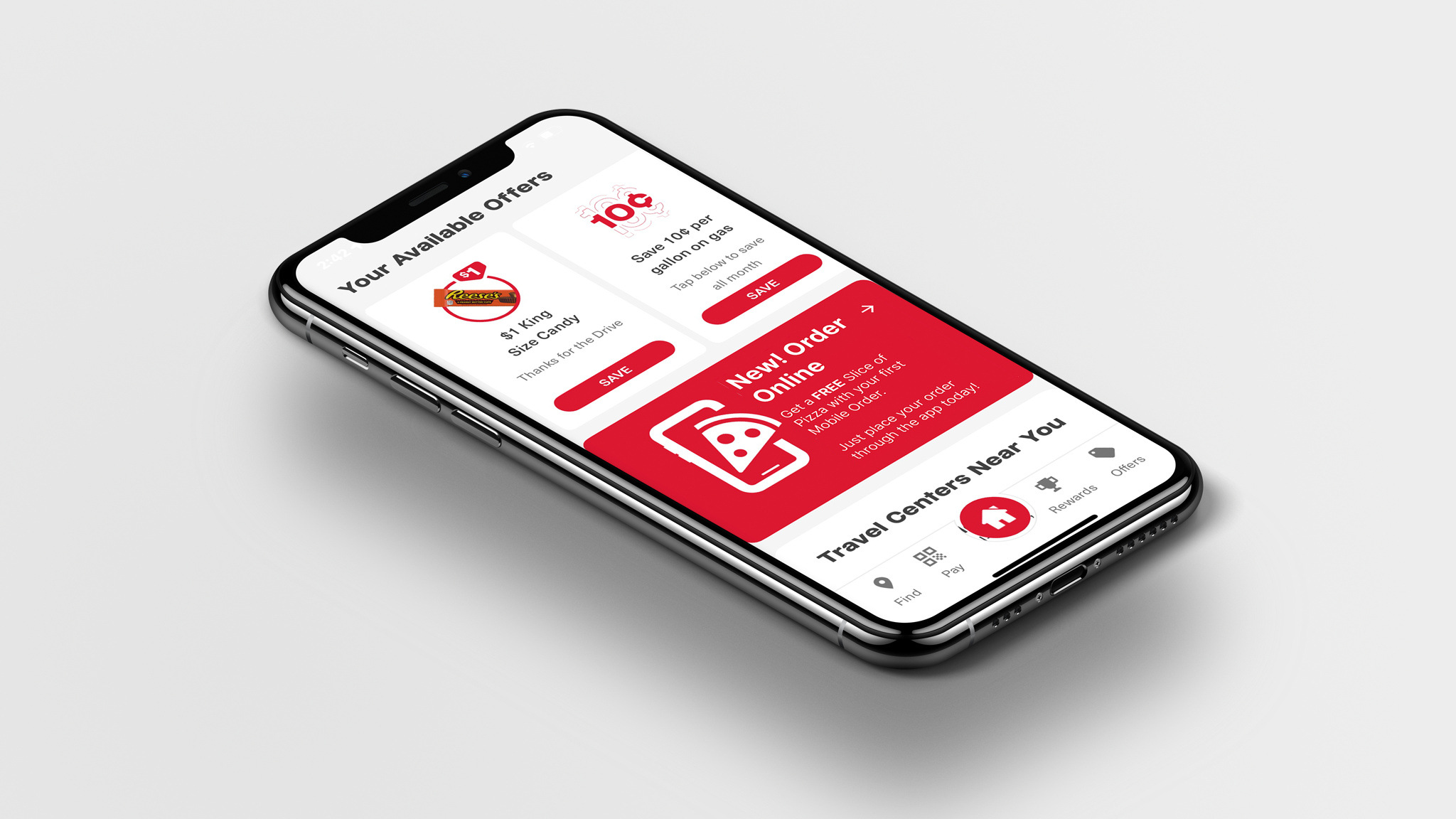
“launched mobile ordering with welcome offer generating 2.2K+ mobile transactions within 2 weeks of go-live”
Business Goal
Transform Pilot from being primarily known as a fuel stop into a reliable, convenient food destination by launching Mobile Ordering & Order Ahead directly in the Pilot app. The initiative aimed to:
- Establish brand awareness on the platform, engaging customers while establishing first-time transactions and becoming loyalty members
- Grow food & beverage sales through first-party digital channels
- Improve convenience and order accuracy for guests on the road
- Reduce dependency on third-party delivery commissions while still leveraging marketplace reach
- Create repeatable, scalable store workflows for consistent guest experience across locations
Background
Pilot’s early digital success came through third-party delivery platforms (DoorDash, Uber Eats, Grubhub). These partnerships helped build foundational practices around:
- Menu & modifier structuring
- Bagging and labeling workflows
- Basic staging / pick-up coordination
However, first-party Mobile Ordering introduced new requirements:. Guests, not delivery drivers, would be picking up orders.
This shift required:
- Creating brand awareness in-store that coincides with app experience
- Clear pickup signage and location flow
- Standardized bagging and condiment workflows
- Defined refund and exception handling
- Training & adoption support for store teams
Additionally, menu expansion beyond pizza into hot deli, grab-and-go, wings/tenders, and cold case offerings increased order complexity — making operational consistency essential.
Role
As Business Stakeholder & Digital Product Manager, I connected Product + UX Design + Store Operations + Support + Consumer Insights to ensure the mobile ordering consumer experience worked both digitally and operationally.
My goal: create a seamless and reliable end-to-end experience, from the digital interface to the final pickup.
Core responsibilities:
- Engage and retain customers
- Authored the business case and rollout strategy
- Translated store workflows into product requirements
- Established bagging, condiment, labeling & staging standards
- Built cross-team alignment frameworks for execution consistency
- Created and maintained the Guest Feedback, insight, and fix loop
Project required working closely with:
- Marketing
- Product & UX Design
- Product & Engineering
- Operations Excellence & Field Teams
- Food & Beverage Leadership
- Customer Support
- Consumer Insights
- Guest Services
Service Ecosystem: Who Powers Mobile Ordering
Third-party delivery platforms (DoorDash, Uber Eats, Grubhub) played a supporting but influential role in the Mobile Ordering ecosystem by providing marketplace reach, operational learning, and expectation benchmarks.
Mobile Ordering was intentionally built with parity across menus, menu setup, and in-store workflows—including modifiers, prep standards, and packing so store teams could execute consistently without switching mental models between channels, ensuring guests received a reliable experience regardless of where an order originated.
Food & Beverage played a direct role in the ecosystem, with menu structure, prep standards, and condiment logic directly impacting order accuracy, refunds, and guest trust. Treating Food & Beverage as a core stakeholder rather than a background function ensured operational decisions were informed by real performance data and guest behavior, enabling faster iteration and more consistent execution across stores.
In this model, third-party delivery functioned as a learning and acquisition engine, while Mobile Ordering served as the loyalty, margin, and repeat-behavior engine, allowing Pilot to scale digital food ordering while retaining ownership of the end-to-end service experience.

The End-to-End Service Experience
As Mobile Ordering expanded beyond pizza and delivery into first-party pickup, it became clear that success depended less on UI alone and more on how digital experiences, store workflows, systems, and support teams worked together.
To address this, I created an end-to-end service blueprint that mapped the full Mobile Ordering lifecycle—from discovery and checkout through fulfillment, pickup, refunds, and continuous improvement.
The blueprint aligned:
- Guest behavior and expectations
- Frontstage experiences (app, signage, messaging)
- Backstage store workflows and support processes
- Systems, metrics, and ownership
This became the shared operating model used to identify breakdowns, prioritize fixes, and scale Mobile Ordering consistently across locations.


The cropped view highlights the most critical phases of Mobile Ordering—where guest trust is established and operational execution determines success.
Mapping discovery through preparation across guest, frontstage, and backstage made it clear that most experience failures originated behind the scenes, even though they surfaced in the app.
- Discovery success depends on backstage readiness, not just UI
- Order confidence comes from operational logic being correct before checkout
- Acceptance is the trust moment, the guest believes the order is real
- Preparation is where most failures happen, even though the guest can’t see it
This insight guided decisions around menu accuracy, order acceptance, fulfillment standards, and training.
Business Insight
We were already running third-party delivery through DoorDash, Uber Eats, and Grubhub — which gave us mental models to work with.
Delivery surfaced operational patterns:
- Missing condiments which caused instant guest frustration
- Bagging process was not effecient which slows pickup
- If pickup isn’t signed clearly guests feel lost
- Refund handling must be consistent to maintain trust
- Drive website and app traffic, build brand awareness
Instead of starting from scratch, we built Mobile Ordering on top of what worked and improved what didn’t.
Mobile Ordering wasn’t meant to replace delivery, it complements it:
- Delivery drives reach
- Mobile Ordering drives loyalty, margin, and repeat behavior
Customer Experience
Established a welcome offer experience that converts intent into action by rewarding users at the exact moment of sign-up.
Problem
Traffic does not convert users not loyal members. Guests lacked an immediate, tangible reason to create an account. Adoption of the app was also a concern as guests are introduced to new behaviors.
Strategy
New users are promoted to download the app and join the loyalty program to unlock a free slice of pizza, the offer saves to their account once the account is created, and is redeemable before checkout.
Customer Engagement
Bring a clear value proposition t entry points, making sure several entry points are accessible. This allows them to Join the program, save the offer, and redeem at checkout.
- Reward immediately when added to checkout to reduce friction
- Redemption at checkout reinforces behavior and perceived value

Outcome
The flow transformed loyalty from passive concept into active, non- loyalty members into reward members, with a value driven experience. Converting anonymous traffic into registered users, increasing first-order transactions, establishing early habits that support long-term retention.
Third-Party vs Mobile Operations
Each platform has its own personality—different user habits, interfaces, and technology. We had to recognize those nuances and adjust our approach so the experience felt seamless no matter where guests ordered.
| Factor | Third-Party Delivery | Pilot Mobile Ordering | Operational Impact |
|---|---|---|---|
| Pickup | Drivers pick up | Guests pick up | Requires signage and clear handoff points |
| Business Value | Reach & new customer acquisition | Loyalty, repeat behavior, margin retention | Internal channel holds highest lifetime value |
| Data Ownership | Marketplace owns guest data | We own behavioral and order data | Enables personalization and offer strategy |
| Operational Focus | Bag for driver | Bag for guest presentation and clarity | Requires standardized pick and packing workflow |


Market & CX Research
We looked at how other brands handle customization, pickup, and fulfillment. We grounded decisions utilizing mental models from our competitors:
| Brand | Learning | Applied Change at Pilot |
|---|---|---|
| CAVA | Ingredient customization is easier when modifiers are grouped | Grouped toppings and sauces in menu UI |
| Starbucks Pickup | Bag labeling + staging must be visible from entry path | Standardized label placement + pickup shelf visibility |
| First Watch To-Go | Condiments pre-bundled reduce accuracy issues | Built condiment kits prepped at shift start |
| Love’s Travel Stops | Lack of directional signage creates confusion | Designed pickup signage templates and location placement guidance |
We also performed observational store walk-throughs, time studies, and Food Business Partners ride-alongs to understand:
- Prep rhythm
- Team communication during peak hours
- Space constraints by store layout
- The “mental load” of bagging vs. serving walk-in guests
Blueprint Input
Insight: from store walk-throughs, time studies, and ride-alongs were mapped directly into the service blueprint to ensure workflows were realistic under peak-hour pressure—not just ideal-state designs.
The product can only succeed if the end-to-end workflow is fast, clear, and repeatable under pressure. Guests want food ordering to feel effortless and predictable.
Operational Enhancements
Blueprint Execution
Once the end-to-end service was mapped, recurring failure points became clear; particularly around fulfillment, bagging, pickup, and refunds. The following enhancements were designed to address those specific breakdowns.
Fulfillment standards were created to reduce complexity and elevate the guest experience. The enhancement had business and guest impact. These standards create ease of operation for the team members and elevated experiences for the guest.
Condiment Standards
Guests care about condiments more than we think. Missing condiments = instant frustration.
Solution
- Created a condiment pairing matrix for every menu item
- Introduced pre-built condiment kits for simpler pack-out
- Added visual prompts at the assembly station
This alone reduced refund requests tied to “missing item.”
Example of condiment offerings:
- Packets: Ketchup, Mustard, Mayo
- Dips: Ranch, BBQ, Honey Mustard, Blue Cheese
Example of condiment by category:
- Whole and Sliced Pizza: Crushed red pepper, Parmesan cheese
- Chicken: All packets and dips


Bagging & Label-First Workflow
Before mobile ordering, every store bagged differently — which meant guests sometimes couldn’t tell which order was theirs.
Solution
- Standardized bag size
- Implemented a label-first workflow
- Created visual pack-out diagrams (especially for hot + cold orders together)
This improved speed, consistency, and guest confidence at pickup.


Pickup Zone Signage
Pickup only works when you know where to go.
We designed clear signage and recommended placement by store layout, so guests never have to ask.
This reduced counter congestion and supported staff during peak hours.


| Area | Change Implemented | Result |
|---|---|---|
| Condiments | Created condiment pairing standards and ready-to-grab kits | Reduced missing item complaints & improved guest satisfaction |
| Bagging Workflow | Standardized mobile ordering pick and packing procedures | Faster fulfillment and clearer pickup identification |
| Pickup Staging & Signage | Rack and signage placement based on store format | Reduced “Where do I go?” questions & counter congestion |
Refunds & Guest Feedback Loop
Created a structured feedback loop with prioritization and a follow up system to field ops team and product teams for improvement.
- Inputs: Support tickets, app feedback, field manager reports, refund data
- Analysis: Identify patterns (e.g., condiments missing at open, pickup signage creates low visibility)
- Action: Deliver workflow and UX + communication updates
- Validation: Field test → rollout → reassess
This allowed Mobile Ordering to improve after launch, and not become stagnate.
Solution
- A repeatable system to convert guest and field feedback into product and operational improvements.
Inputs Used
- Guest support tickets
- App and store signage usability feedback
- Food Business Partners surveys
- Menu performance and refund analytics trends
Outputs Produced
- Menu configuration simplifications
- Condiment pair defaults added to packs
- Pickup signage moved to higher visibility zones
- UX naming and layout improvements
Outcome
- Continuous improvement driven by real behavior, not assumptions.
Business & Guest Impact
With operational enhancements, a refund process in place and a feedback loop implemented.
- Condiment Standards: Fewer remake requests, improved completeness
- Bagging Workflow: Faster fulfillment and easier guest identification
- Pickup Staging & Signage: Reduced confusion and counter congestion
- Refund & Support Flow: Faster resolution and higher trust
Workflows became consistent across stores which lowered stress for travelers & pro drivers. Reduced refund and remake costs which increased confidence the order will be right. Strengthened brand perception as a food destination which encouraged repeat ordering behavior.
Takeaways
Even though the deadline was tight, we followed a mental model based on other popular apps‘ patterns.
Digital success only happens when store workflows support the promise. Third-party delivery was our operational test bed — we matured from there. Small details (condiments, labeling, signage) drive large experience outcomes.
With business and operational knowledge, I was to integrate business goals and UX design with real-world execution.
| Learned from Third-Party Delivery | How it Applied to Pilot Mobile Ordering |
|---|---|
| Drivers need fast, clear pickup zones | Guests need clear pickup zone signage & staging areas |
| Delivery errors often stem from missing condiments | Created condiment pairing Standards + pre-built condiment kits |
| Bagging inconsistencies slow handoff | Implemented label-first bagging workflow to increase speed & identity clarity |
| Refund friction reduces trust & costs money | Built refund & recovery playbook with scenario-based paths |
